
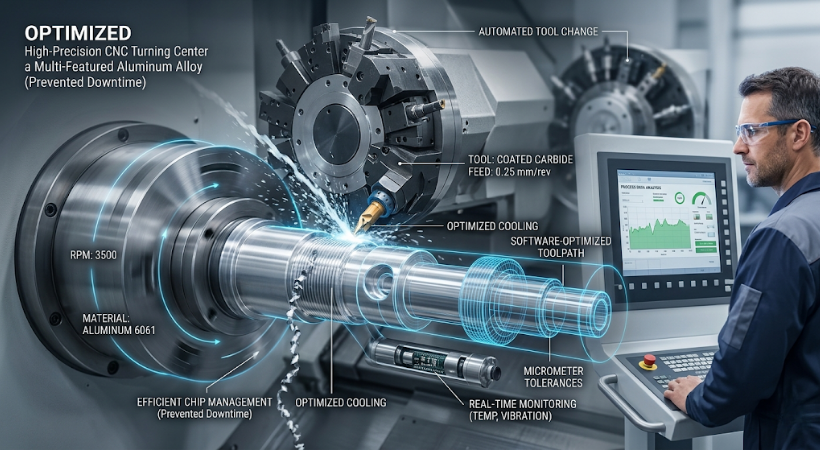
CNC Turning Process Optimization: Techniques, Challenges & Efficiency Improvement
Did you know that up to 30% of downtime in CNC manufacturing is caused by poor chip management?
CNC turning is a core manufacturing technology that enables the precise production of components made from metal, plastic, and composite materials. Optimizing the process not only improves quality but also reduces costs and scrap.
In this article, you will learn practical techniques, common error sources, and strategies to increase efficiency.
Basics of CNC Turning
What is CNC Turning?
CNC turning refers to the computer-controlled machining of rotating workpieces. Unlike manual turning, a computer controls the tools and axes, enabling the production of complex geometries with high precision. Typical components include shafts, bolts, housings, or fastening elements.
Typical Materials & Machining Tips
| Material | Challenge | Tool / Process Tips |
|---|---|---|
| Steel | Hardness & Wear | Carbide tools, moderate cutting speed |
| Aluminum | High thermal conductivity | Higher spindle speeds, coated tools |
| Brass | Material softness | Light feed, optimized cooling |
| Titanium | Low thermal conductivity, high tool load | Low cutting speed, special coolants |
| Plastic | Deformation | Low spindle speeds, controlled cooling |
If you have read this blog article up to this point, we have a special offer for you: The first customers who contact us regarding our CNC turning will receive an exclusive 10% discount! Take advantage of this opportunity to implement your projects efficiently and precisely. Call us now or visit our CNC turning page to learn more and benefit from this offer.
+90 533 242 25 73
Common Challenges in CNC Turning
Sources of Errors and How to Avoid Them
Incorrect cutting speed or feed rate: Optimize speed and feed according to the material.
Improper tool selection: Consider coating, geometry, and toolpath optimization. CAD/CAM adjustments help prevent typical errors.
Inaccurate workholding: Use stable vises and proper multi-clamping setups.
Quality Issues
Surface roughness too high → Adjust speed, feed, and cooling
Dimensional or form deviations → Check CAD/CAM data, ensure repeatability
Vibrations → Calibrate machine, optimize clamping
Tips for Process Optimization
Adjust tool and machine parameters
Select spindle speed, feed rate, and depth of cut according to material
Coated tools increase tool life
Perform regular machine maintenance
Effective chip and coolant management
Proper chip evacuation and coolant control prevent tool wear and surface defects, increase tool life, and reduce downtime.
Process monitoring and automation
Real-time monitoring (temperature, vibration, tool wear) → increases machine availability, reduces scrap costs
Automated tool changes reduce downtime
Software-based toolpath optimization minimizes errors
Production Planning and Best Practices
Optimize turning sequence
Consider raw material selection and fixturing
Document and analyze process data
Practical Examples of Optimized CNC Turning
- Aluminum shaft for automotive industry: Optimized spindle speed and cooling led to 20% faster production with identical surface quality.
- Brass bolts: Use of coated tools reduced tool wear by 30%.
- Plastic parts: Adjusting feed rate and coolant prevented deformation and dimensional deviations.
What is meant by CNC turning?
CNC turning is a computer-controlled machining process in which a rotating workpiece is precisely machined using a stationary cutting tool. It is particularly suitable for shafts, bolts, sleeves, and other rotationally symmetric components.
Which materials are typically used in CNC turning?
Commonly used materials include steel, aluminum, brass, titanium, and various plastics. Each material has its own requirements regarding cutting parameters, cooling, and tool geometry.
What challenges frequently occur in CNC turning?
Typical issues include incorrect cutting speeds, unsuitable tool selection, inaccurate workholding, dimensional deviations, surface defects, and vibrations. These problems can be reduced by optimizing parameters and using high-quality tools.